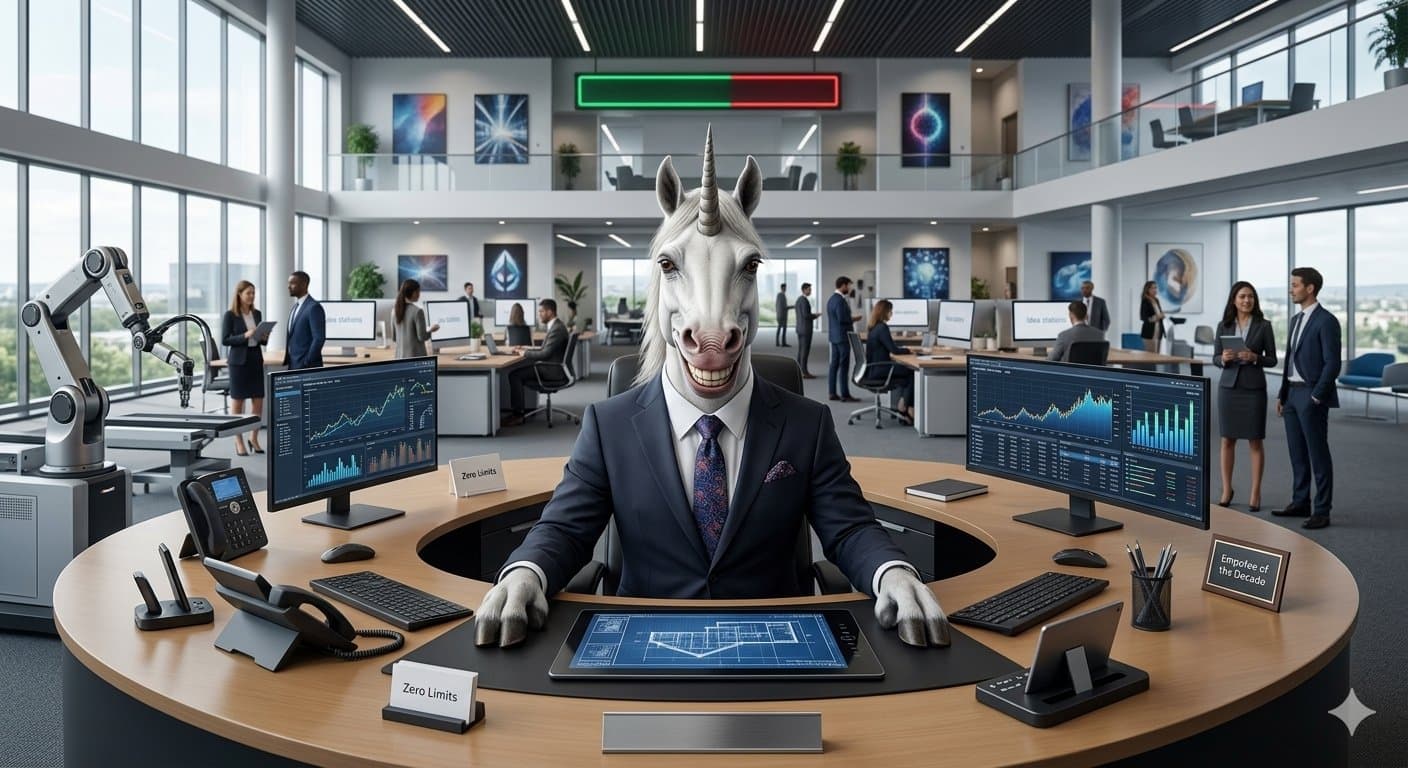
You've seen the job ad. It reads something like:
"We're looking for a marketing manager who can think strategically AND write copy AND manage social media AND brief designers AND analyse campaign data AND coordinate the website... We know this is a unicorn role and we're realistic about finding someone who excels at ALL of these. But tell us what you're great at and we'll go from there."
The "we know this is unrealistic" disclaimer is doing a lot of work in that paragraph. It's both honest and quietly devastating - an admission that what the business actually needs is a person who doesn't exist, followed by an invitation to settle for whoever turns up.
Here's the thing though. For a small or medium business, that person - the one who can hold strategy and execution simultaneously across a wide range of disciplines - isn't actually a myth. They're just rare, and the job ad is usually looking for them in the wrong places.
Why the Unicorn Myth Persists
The myth exists because most people who call themselves "full-stack creative" or "do-it-all marketers" are really generalists - people with broad awareness of many things and genuine depth in none of them. They know what a brand strategy is without ever having built one from scratch. They can brief a photographer without being able to pick up a camera themselves. They understand SEO in principle but have never actually ranked a page.
Breadth without depth isn't a unicorn. It's just someone who reads a lot.
The genuine article - someone with real depth across strategy, brand, content, creative production, web and SEO - is rare for an obvious reason: accumulating genuine depth across that many disciplines takes decades, not a career change.
What a Real Creative Unicorn Actually Looks Like
I didn't set out to be a generalist. I started as a musician and photographer, picked up filmmaking because I couldn't afford to hire one, got into marketing because clients kept asking me what their brand should be doing, learned web development because the sites I was asked to improve were genuinely terrible, and got deep into SEO because content without visibility is just a very expensive diary.
Twenty-five years later, I can do all of those things - not at a junior level because I've dabbled, but at a senior level because I've spent decades going deep on each of them. The strategy session in the morning and the camera in the afternoon aren't a party trick. They're just what happens when you've never stopped learning.
That's the difference between a generalist and a genuine creative unicorn: a generalist has touched everything; a unicorn has genuinely mastered several things that usually belong to different people.
Why Small Businesses Actually Need One
Large companies can hire a CMO and build a team around them. Specialists for every discipline. Agency relationships for overflow. A full-stack creative is, at that scale, inefficient - too slow, too broad, not enough output.
But for an SME or a startup? The team-of-specialists model is genuinely out of reach. You can't hire five people. You can't afford to manage five agencies. And you definitely can't afford the version of this where your web designer doesn't understand your brand strategy, your photographer has never read your brief, and your social media manager is posting things that contradict your positioning.
What you need is one person who holds the whole picture at once. Someone who writes the strategy, can execute it across multiple channels, knows when to bring in specialist support and can brief them properly, and keeps the creative thread consistent from the first conversation to the final asset.
That's not a unicorn. That's just what a senior creative consultant is supposed to be.
The Job Ad Is Asking the Right Question
When a business posts a "unicorn" role, they're usually describing their actual problem accurately, even if they're resigned to not solving it. They need integrated thinking. They need someone who doesn't just hand over a strategy deck and leave. They need the rare thing: senior-level breadth backed by genuine depth.
I've spent 25 years becoming that person - not because I planned it, but because every client problem I couldn't solve sent me back to learn something new. Wesley Mission needed better storytelling, so I got better at film. Tasman Holiday Parks needed someone who could think about the brand and shoot the content on the same trip. Eliézer Clay needed a brand, a website, packaging, photography, and a launch plan - all at once, all coherent.
The businesses that work with me aren't settling. They're finding the thing the job ad said didn't exist.
So, Is That You?
If you're running a small or medium business and you're tired of:
- Briefing five different people who've never spoken to each other
- Getting a strategy document that nobody knows how to execute
- Watching your marketing budget disappear with nothing to show for it
- Having a website that looks nothing like your brand, a brand that sounds nothing like you, and content that contradicts both
...then what you're looking for isn't a unicorn. It's a senior creative consultant who's been around long enough to have actually done all the things.
Start with a free Brand Health Check. It takes five minutes and tells you exactly where the gaps are. No forms, no junior account managers, no discovery calls designed to upsell you. Just a direct answer to what your business actually needs.
The unicorn job ad is really just a business describing its problem honestly. I'm glad someone is finally answering it.